


Bucknell University Athletics
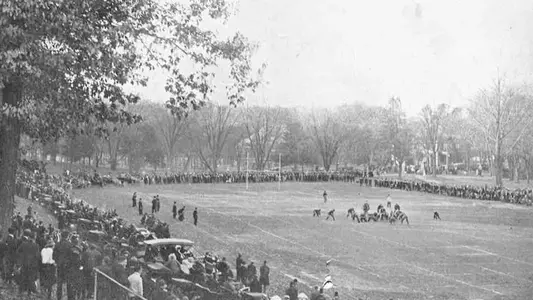
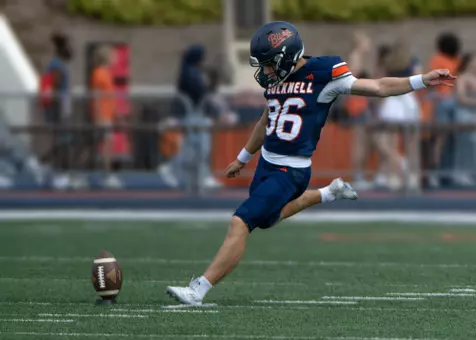
Photo by: Bucknell Athletics
100 Years Ago: Bucknell Football Posts Unbeaten Record with Backdrop of War, Spanish Flu
10/8/2018 10:03:00 AM | Football
Bucknell has had a number of noteworthy football teams throughout its storied history, but one of the most overlooked is the 1918 squad that finished a perfect 6-0, joining the 1951 team as the only two unbeaten and untied units in the history of a program that debuted way back in 1883. As we hit the 100-year anniversary of the 1918 season, it is worth taking a closer look at an era of Bucknell football that is not particularly well-known.
Times were obviously very different in 1918, globally and here in Lewisburg. Two major world events – the Great War and the killer Spanish Flu pandemic – loomed as the backdrop at the time, and both significantly impacted that Bucknell football season.
With World War I in full force, the Bucknell Board of Trustees had voted to disband formal varsity athletic teams prior to the start of the 1918-19 academic year. At the same time, Bucknell, along with colleges and universities all over the country, began enrolling students under the Students' Army Training Corps (SATC), which was an initiative of the War Department to combat declining college enrollment. This influx of trainees, who would take college courses while preparing to join the fight in Europe, resulted in a record-setting freshman class of 382 students. The total enrollment swelled to 689, which caused overcrowding in the classrooms and a shortage of supplies in the bookstore.
Capt. James Beazley, USAFA, was the commanding officer of the SATC at Bucknell and Susquehanna, and he was also an avid supporter of athletics, particularly football. Bucknell had not been particularly successful in recent seasons (8-20-4 from 1915-17), but Capt. Beazley made several of his finest athletes from the SATC available to the football team, where they joined a young but improving returning cast.
A few years earlier, Edgar Wingard, a Selinsgrove native who had previously produced championship teams at LSU and Maine, returned home to coach the Susquehanna football team. Wingard was then hired to coach the Bucknell squad in 1918, but when the Board of Trustees cancelled varsity athletics, his contract was nullified. Wingard returned to Susquehanna to serve as director of athletics, but then Capt. Beazley stepped in with funding, and Wingard was brought back on board at Bucknell.
It proved to be a wise move, as it was quickly apparent that his coaching experience would pay dividends. The Oct. 7 edition of The Bucknellian reported, "During the short time that Mr. Wingard has been here he has made a very favorable impression on the football men and the school at large, and under his direction Bucknell can be confident of having a team which will be a credit to the institution."
The team was scheduled to open the 1918 season against mighty Penn at Franklin Field. But the game was called off at the request of Philadelphia health officials. The Spanish Flu was raging in all corners of the globe, including the northeastern United States. An estimated 50 million flu-related deaths between 1918-20 resulted in the world's population being reduced by nearly five percent, according to some estimates. On campus, dozens of students fell ill and were sent into quarantine, and several died from the resulting pneumonia. What made this particular strain of influenza so tricky to deal with was that it seemed to target healthy young adults. Particular caution was paid to contact sports, such as football.
Upon word of the cancellation of the Penn game, Bucknell officials scrambled to schedule a home game with Bellefonte Academy. The contest was played in a driving rain, and reports indicated that only two spectators were on hand at the start, but more hardy rooters came out once word spread that an actual football game was being played and not just a practice. It was a successful debut, as team captain Waddell (the great-grandfather of Bucknell Hall-of-Fame golfer Charlie Waddell) scored two touchdowns and Kostos had one in the first half, and Bucknell went on to win 31-0.
One week later, Bucknell traveled to State College by "automotive truck" for a highly anticipated game against Penn State at Beaver Field. Both teams were warming up and the band played as the spectators assembled, but one hour before kickoff a cable came in from Harrisburg stating that the State Board of Health was canceling the game.
From The Bucknellian: "The Bucknell men were in fine form and good spirits and from the way they sized up the rather light State squad they feel confident that they could have made things interesting for the collegians."
It would be another two weeks before the Bucknell football squad would get an opportunity to take on an opponent, but once the schedule resumed, so did the string of dominating victories. On Nov. 2, despite a significant size disadvantage, Bucknell licked Mount St. Mary's 47-0, highlighted by Brandt's length-of-the field kickoff return touchdown. Even better, the flu quarantine had been lifted just days earlier, resulting in high spirits and one of the largest crowds ever seen at the time. It would be another six years until Memorial Stadium would be constructed, so the games were played on a grass patch by Tustin Gymnasium, near the site of the current Gateway residence halls.
A week later, Bucknell and Villanova (or Villa Nova, as it was noted at the time) met just down the road in Sunbury. There was plenty of pageantry, with a pregame march-on and large throngs of fans wearing military uniforms. Villanova came in slightly favored, but Bucknell used its superior speed to race to a dominant 40-0 win.
One of Bucknell's biggest rivals at the time was Gettysburg, and the two teams often met halfway to play in Harrisburg. The Lewisburg contingent took a special train to Harrisburg and then paraded through the city streets to the team headquarters at the Columbus Hotel. Both teams had military bands, and spirits were at an all-time high, as the Great War had come to an end earlier that week -- at 11 a.m. on 11/11 – when the Germans signed the armistice with the allies that stopped the fighting.
Bucknell and Gettysburg were similar in size, but Bucknell appeared to be better coached and trained. The squad made play after play in the open field, highlighted by Lewis' 80-yard touchdown gallop in the first quarter, and Bucknell vanquished the Battlefield Boys by a 27-0 count. Afterward, they marched back through the streets of Harrisburg to show the locals which side was victorious.
In the next edition of The Bucknellian, the editorial implored, "Now that the war is over, do not let your interest in military work and studies lag. Keep up the old fighting spirit, for it is going to be the best for us all in the long run."
Bucknell returned to Sunbury on Nov. 23 and routed Wingard's former Susquehanna team 47-7 before another huge crowd that included most of the student bodies from both sides. Bortz shined for Bucknell after returning from injury, while quarterback Bateman stood out for Susquehanna. His touchdown would be the only points allowed by Bucknell all season.
On short rest, Bucknell came right back on Nov. 26 – Thanksgiving Day – and walloped Dickinson 44-0 at home to cap off a perfect season in which the team outscored its opponents 236-7.
Afterward, many reports bestowed heavy praise on two individuals in particular: Capt. Beazley and Edgard Wingard. Without Capt. Beazley's support of football and his financial backing, it is very possible that Bucknell would not have fielded a football team in 1918, much less one for the record books.
For Wingard, it would be his only season at Bucknell. He returned to Susquehanna the following year and led his hometown squad to a 5-4-1 record, although one of the losses came to Bucknell. Lauded for his organization, tactics and enthusiasm, Wingard would compile a 77-39-5 lifetime record at Ohio Northern, Butler, Western University of Pennsylvania (now Pittsburgh), LSU, Maine, Susquehanna and Bucknell. He passed away from a brain hemorrhage in 1927.
Even though Wingard departed, Bucknell would remain strong on the gridiron. The team finished 5-4-1 in 1919 under new mentor Pete Reynolds, and Bucknell would suffer only two losing seasons from 1918 up to 1945, when yet another worldwide conflict was winding up.
An abridged version of this feature story originally ran in the program for Bucknell's game against Colgate on Oct. 6, 2018.
Times were obviously very different in 1918, globally and here in Lewisburg. Two major world events – the Great War and the killer Spanish Flu pandemic – loomed as the backdrop at the time, and both significantly impacted that Bucknell football season.
With World War I in full force, the Bucknell Board of Trustees had voted to disband formal varsity athletic teams prior to the start of the 1918-19 academic year. At the same time, Bucknell, along with colleges and universities all over the country, began enrolling students under the Students' Army Training Corps (SATC), which was an initiative of the War Department to combat declining college enrollment. This influx of trainees, who would take college courses while preparing to join the fight in Europe, resulted in a record-setting freshman class of 382 students. The total enrollment swelled to 689, which caused overcrowding in the classrooms and a shortage of supplies in the bookstore.
Capt. James Beazley, USAFA, was the commanding officer of the SATC at Bucknell and Susquehanna, and he was also an avid supporter of athletics, particularly football. Bucknell had not been particularly successful in recent seasons (8-20-4 from 1915-17), but Capt. Beazley made several of his finest athletes from the SATC available to the football team, where they joined a young but improving returning cast.
A few years earlier, Edgar Wingard, a Selinsgrove native who had previously produced championship teams at LSU and Maine, returned home to coach the Susquehanna football team. Wingard was then hired to coach the Bucknell squad in 1918, but when the Board of Trustees cancelled varsity athletics, his contract was nullified. Wingard returned to Susquehanna to serve as director of athletics, but then Capt. Beazley stepped in with funding, and Wingard was brought back on board at Bucknell.
It proved to be a wise move, as it was quickly apparent that his coaching experience would pay dividends. The Oct. 7 edition of The Bucknellian reported, "During the short time that Mr. Wingard has been here he has made a very favorable impression on the football men and the school at large, and under his direction Bucknell can be confident of having a team which will be a credit to the institution."
The team was scheduled to open the 1918 season against mighty Penn at Franklin Field. But the game was called off at the request of Philadelphia health officials. The Spanish Flu was raging in all corners of the globe, including the northeastern United States. An estimated 50 million flu-related deaths between 1918-20 resulted in the world's population being reduced by nearly five percent, according to some estimates. On campus, dozens of students fell ill and were sent into quarantine, and several died from the resulting pneumonia. What made this particular strain of influenza so tricky to deal with was that it seemed to target healthy young adults. Particular caution was paid to contact sports, such as football.
Upon word of the cancellation of the Penn game, Bucknell officials scrambled to schedule a home game with Bellefonte Academy. The contest was played in a driving rain, and reports indicated that only two spectators were on hand at the start, but more hardy rooters came out once word spread that an actual football game was being played and not just a practice. It was a successful debut, as team captain Waddell (the great-grandfather of Bucknell Hall-of-Fame golfer Charlie Waddell) scored two touchdowns and Kostos had one in the first half, and Bucknell went on to win 31-0.
One week later, Bucknell traveled to State College by "automotive truck" for a highly anticipated game against Penn State at Beaver Field. Both teams were warming up and the band played as the spectators assembled, but one hour before kickoff a cable came in from Harrisburg stating that the State Board of Health was canceling the game.
From The Bucknellian: "The Bucknell men were in fine form and good spirits and from the way they sized up the rather light State squad they feel confident that they could have made things interesting for the collegians."
It would be another two weeks before the Bucknell football squad would get an opportunity to take on an opponent, but once the schedule resumed, so did the string of dominating victories. On Nov. 2, despite a significant size disadvantage, Bucknell licked Mount St. Mary's 47-0, highlighted by Brandt's length-of-the field kickoff return touchdown. Even better, the flu quarantine had been lifted just days earlier, resulting in high spirits and one of the largest crowds ever seen at the time. It would be another six years until Memorial Stadium would be constructed, so the games were played on a grass patch by Tustin Gymnasium, near the site of the current Gateway residence halls.
A week later, Bucknell and Villanova (or Villa Nova, as it was noted at the time) met just down the road in Sunbury. There was plenty of pageantry, with a pregame march-on and large throngs of fans wearing military uniforms. Villanova came in slightly favored, but Bucknell used its superior speed to race to a dominant 40-0 win.
One of Bucknell's biggest rivals at the time was Gettysburg, and the two teams often met halfway to play in Harrisburg. The Lewisburg contingent took a special train to Harrisburg and then paraded through the city streets to the team headquarters at the Columbus Hotel. Both teams had military bands, and spirits were at an all-time high, as the Great War had come to an end earlier that week -- at 11 a.m. on 11/11 – when the Germans signed the armistice with the allies that stopped the fighting.
Bucknell and Gettysburg were similar in size, but Bucknell appeared to be better coached and trained. The squad made play after play in the open field, highlighted by Lewis' 80-yard touchdown gallop in the first quarter, and Bucknell vanquished the Battlefield Boys by a 27-0 count. Afterward, they marched back through the streets of Harrisburg to show the locals which side was victorious.
In the next edition of The Bucknellian, the editorial implored, "Now that the war is over, do not let your interest in military work and studies lag. Keep up the old fighting spirit, for it is going to be the best for us all in the long run."
Bucknell returned to Sunbury on Nov. 23 and routed Wingard's former Susquehanna team 47-7 before another huge crowd that included most of the student bodies from both sides. Bortz shined for Bucknell after returning from injury, while quarterback Bateman stood out for Susquehanna. His touchdown would be the only points allowed by Bucknell all season.
On short rest, Bucknell came right back on Nov. 26 – Thanksgiving Day – and walloped Dickinson 44-0 at home to cap off a perfect season in which the team outscored its opponents 236-7.
Afterward, many reports bestowed heavy praise on two individuals in particular: Capt. Beazley and Edgard Wingard. Without Capt. Beazley's support of football and his financial backing, it is very possible that Bucknell would not have fielded a football team in 1918, much less one for the record books.
For Wingard, it would be his only season at Bucknell. He returned to Susquehanna the following year and led his hometown squad to a 5-4-1 record, although one of the losses came to Bucknell. Lauded for his organization, tactics and enthusiasm, Wingard would compile a 77-39-5 lifetime record at Ohio Northern, Butler, Western University of Pennsylvania (now Pittsburgh), LSU, Maine, Susquehanna and Bucknell. He passed away from a brain hemorrhage in 1927.
Even though Wingard departed, Bucknell would remain strong on the gridiron. The team finished 5-4-1 in 1919 under new mentor Pete Reynolds, and Bucknell would suffer only two losing seasons from 1918 up to 1945, when yet another worldwide conflict was winding up.
An abridged version of this feature story originally ran in the program for Bucknell's game against Colgate on Oct. 6, 2018.
Thursday, August 27
Wednesday, August 26
Sunday, August 23
Friday, August 21