Bucknell University Athletics
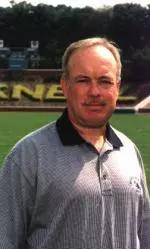
Bucknell Remembers Tom Gadd
3/5/2003 7:00:00 AM | Football
March 5, 2003
Written by Bo Smolka
Lewisburg is a little smaller place today, now that Tom Gadd is no longer here.
Gadd, the Bison's highly successful football coach who died early Saturday morning after a two-year battle with brain cancer at age 55, will be memorialized in Bucknell's Rooke Chapel today (Wednesday). Friends, family and former players will gather and no doubt relive some of the great moments of his too-short life.
But more than any of his wins, more than his competitive spirit, more than his genuine sincerity, what I'll remember most about Tom Gadd is the way this 'outsider' from the West Coast settled into Bucknell, Lewisburg and the Susquehanna Valley and made them his own. I'll remember how he paid back in spades those people who were willing to take a chance and hire this non-Bucknellian, non-Ivy, non-Patriot Leaguer.
Bucknell can be a very insular place. Its students refer to the "Bucknell Bubble," as if the picturesque campus is an independent ecosystem. It prides itself on being "the 300 acres set apart."
So there was considerable hesitation on campus when Gadd was hired as the head football coach in December 1994. His resume included stops in big-time Division I football, at places like Minnesota, South Carolina and Utah. He had grown up in California. This guy? Some people wondered. How can this guy possibly fit into a place like Bucknell? He's not one of us.
What they didn't realize then, but came to understand in the ensuing years, is that Gadd was a perfect fit. After an itinerant career as an assistant coach that included six addresses in 13 years, he wanted some stability and a chance to put his mark on a program.
He found both at Bucknell. From the minute he landed in Lewisburg, he set about putting down roots in the Susquehanna Valley. He and his wife, Carol, built a house, and their then-teen-age sons, Jeff and Dan, quickly immersed themselves in the local youth sports scene.
He spent hours with longtime Lewisburg residents like Bud Ranck and Russ Gardner, eagerly absorbing stories about the town's history and dynamics.
He did much the same on campus. I remember his first day as Bucknell coach. He ventured down to my office in Davis Gym and requested copies of recruiting brochures for every Bucknell sport. He said he simply wanted to learn about each program, to get to know its story.
Indeed, when he wasn't up in his office designing some defensive scheme that would stop yet another opponent dead in its tracks, Gadd often could be found at a field hockey game or a volleyball match. I could count on one hand the number of Division I football coaches you could say that about.
When another Bucknell coach passed him in the hall, he was just as happy talking about their team as he was his own. Sure, football got more headlines, but Gadd knew that his program was just one of many at Bucknell. His team was part of Bucknell athletics, not a hair above it.
He knew that other coaches and other players worked just as hard at their craft as he did at his. And if he appreciated anything, it was hard work and commitment.
It showed. Tom Gadd was a great football coach. He was a great motivator of young men. He took a program that had been mediocre for three decades and, infusing it with just the right dose of intensity and passion, turned it into a consistent winner. In 1996, the Bison won their first Patriot League title, and the following season they set a school record with 10 wins. By any measure, the Gadd era will go down as one of the best in Bucknell history.
But more impressive than the victories was the way Gadd understood the whole package. There might be a better recruiter out there. There might be a better game-day coach. There might be a coach who was better at alumni relations (though I highly doubt it considering that, upon his hiring, Tom set about calling every living former Bucknell football player). But when you add up all the components that make up the job description of "football coach" in Division I athletics today, no one met it better than Tom Gadd.
Yes, Bucknell can be an insular place. Tom Gadd helped Bucknell open its eyes and look outward. He taught the university that it's OK to look beyond its Ivy League-Patriot League pedigree every once in a while, because there are still some jewels out there, somewhere beyond the bubble.
Bucknell lost one of those jewels Saturday morning, and that's why it's a smaller place today.