Bucknell University Athletics
Bucknell Women's Rowing Journal - Elizabeth Perry
4/22/2014 5:45:00 PM | Women's Rowing
First, a little bit of background. I'm a coxswain. Well, kind of.
I was recruited to Bucknell as a rower. And that's what I was in the fall, through the winter, all the way up until spring break, when we as a team had a collective moment of – wait a second. We have eight boats, and only four coxswains. This isn't going to work.
One practice I was thrown in the coxswain seat because I could fit and, long story short, I (and eventually three others) became temporary coxswains for the spring season.
So far I have been enjoying it immensely. Talk about the atypical college rowing experience – I have the chance to cox for a season, every rower's dream when they're halfway through a 2k and wonder why they ever decided to pick rowing over coxing in the first place. Don't get me wrong, I miss the feeling of an oar in my hands; but I was lucky enough to be given the opportunity to work with a group of girls that I otherwise would not have necessarily had the chance to work with – the lightweight eight and the rest of Bucknell's lightweight squad – and it has been invaluable.
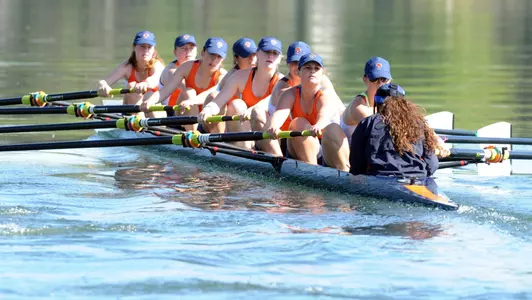
I have already learned so much from them, and it has only been about a month now. Sitting in the coxswain's seat for an experienced crew is something that, though usually not a reasonable request to make of one's coaches, I would recommend ever freshman rower do if ever given the chance. Not only can you feel when the rowers make a change and start moving faster, you can really see exactly what that change was. Something Coach really emphasizes is getting “locked on” at the entry – grabbing onto the water with your oar as quickly and cleanly as possible. As the coxswain, when I echo Coach's words and make a call to focus on locking on, I can see how the women in my boat respond by being patient coming into the front end of the slide and finding immediate resistance on their legs when their blades enter the water; and then, I can feel the boat surge forward as they press through the drive. I know when something is working, and I know when something is not, and because of where I'm sitting I can pinpoint exactly what that thing is. And part of my job is figuring that thing out, so you can believe I'm going to remember it for when I go back to rowing.
But technique is only the beginning of the things I have been learning from them. I thought I knew what it meant to fight to win a race – but after a couple races with the light 8, I realized there was a whole other level a rower and a crew could go to if they wanted it bad enough. And let me tell you, these women go to that level every single stroke of every single race. It's inspiring to witness and be even a small part of. And it is something that I will never be able to describe in words; but I can try.
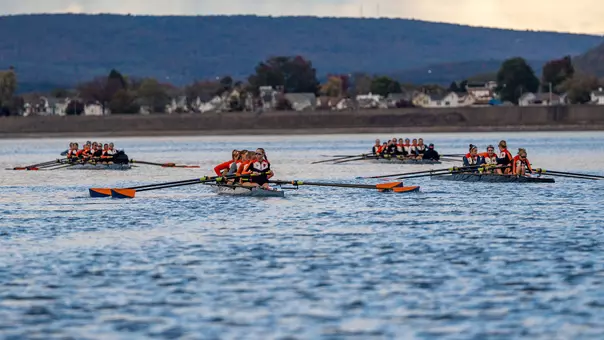
At our most recent regatta, the Knecht Cup on Mercer Lake in New Jersey, I made a costly mistake. At the start, there was a nasty crosswind – one that was constantly blowing us to port, so that my poor three seat had to row with two seat's oar almost continuously to keep our point straight over the ten minutes it took the other teams to get locked on to the stake boats and the officials to line up our bow-balls for an even start. Because the crosswind was so bad, I expected the officials to call the start quickly; so as soon as they called alignment I had all eight sit ready for the start. But the officials started polling the crews – “Tulsa… MIT… Boston… Wisconsin… Bucknell… Princeton…” Meanwhile I'm praying for them to hurry up and call the start as I'm watching our point drift towards port again. Finally, they call “attention, row!” and the first thing I do is try to get us pointed in the right direction again while barking out the start calls and “hard on port!”.
Unfortunately, it was too little too late from me. We swung into Wisconsin's lane and clashed blades – our poor, crisp white blades were sliced with Wisconsin's red paint.
But despite these painted wounds, as soon as we moved back into our lane the race was on. We immediately caught up to Boston University and Princeton, who had gone through their start unscathed, and left Wisconsin down. As Coach Heather had told us before the previous weekend's race (where we battled tremendous gusts of wind on the course), racing is about who gets up faster when they get knocked down. And the women in my boat – they were on their feet a split second after my mistake had gotten them hit pretty hard. It was almost as if they never hit the ground. They were so determined to perform that they were willing to fight for it just as hard as they always did, no matter the circumstances.
I'll admit that for the rest of the race I forgot about the clash of blades at the start. If the women in my boat were willing to leave what happened behind them and compete in this race, I was going to back them up and use everything I had learned to help get them there. And so, we fought our way back. I spent most of the race staring at Princeton's coxswain to my immediate right and Boston University's coxswain two lanes to our left. You can bet I noticed the desperation in both crews while they wondered how they were going to pull out a victory over a boat with as much determination as ours.
We ended up placing third in that race, mere seconds behind Princeton and an inch behind Boston, with Wisconsin coming in fourth a couple seconds behind us. As was their right, Wisconsin protested the clashing of blades, and the officials flipped the results so that we were taken off the medal stand and replaced by Wisconsin.
I may never fully forgive myself for costing the women in my boat a medal that they so rightfully should have won. I've accepted that inevitability. But there is something else I didn't mention earlier that these women of Bucknell's lightweight squad have taught me, beyond a new sense of how to make a boat move with technique and with heart – they have taught me how I want to treat freshmen when I become an upperclassman. They have always, from the beginning, been welcoming to me. They were incredibly patient as I was learning. But they have never gone easy on me. Just as I'll ask more of them in a close race, they wordlessly ask more of me as a coxswain, as a rower, and as a teammate every day. They expect nothing less than excellence from me – and the fact that they believe that I can give that to them has been the greatest motivation I have ever received.
It has been an honor and a privilege to be a part of the same team as these women, and I look forward to (hopefully) staying with them and crushing it at IRA's!
Go Bison!


Players Mentioned