Bucknell University Athletics
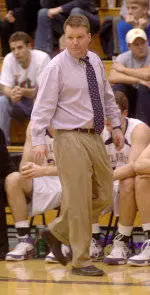
Dave Paulsen Media Conference Quotes
5/21/2008 8:00:00 AM | Men's Basketball
May 21, 2008
LEWISBURG, Pa. -- Dave Paulsen met with members of the media via teleconference on Wednesday morning, one day after being appointed head men's basketball coach at Bucknell.
Below are excerpts from Paulsen's comments to the media.
Opening Comments:
"I am thrilled and excited to be joining the Bucknell program. When people ask me why I was interested in Bucknell, I felt it would take something really special to leave Williams, which is such a great school, my alma mater and a place where we felt very much at home. Bucknell, to me, is a special place where you can combine a real commitment to the student-athletes with high-level academics, with a chance to win Patriot League championships and be nationally prominent in Division I men's basketball. I know that I am inheriting a great, tradition-rich program from Pat Flannery and even his predecessors, and I am looking forward to the challenge of continuing that legacy of success."
On his relationship with Pat Flannery:
"I know Pat well. When I graduated from Williams in 1987 and knew I wanted to get into college coaching, I was working camps all over the country. The very first camp I worked at was a camp in the Pocono Mountains that was run by Bill Foster, who was the head coach at Northwestern at the time. I pulled into the parking lot, and the very first guy I met was Pat. He introduced himself, and we have had a relationship really since that day. I hold him in the highest regard."
On comparing Flannery's systems to his own:
"As an outsider looking in, and I have not been able to watch the team that much, I think there are going to be a lot of similarities. I like to think that we are as defensive-oriented and focused as he is. My understanding is that they played a lot of matchup zone defense, and I've used probably 98 percent man-to-man defensively during my career. There might be some differences there, but as well as I know Pat, I think we both attack the game from the mindset that you have to make it hard for other teams to score. You have to take away easy baskets. Offensively, I've run a motion offense, and Pat has as well. There are a lot of different kinds of motion offenses, a lot of different nuances and approaches. I think mine is probably going to be a little bit different than his, but every year when you structure your motion offense, you do it based on your personnel and their strengths and weaknesses. How we get from Point A to Point B will be a little bit different, but I think the overall philosophy behind it, I would guess would be fairly comparable."
On the decision to leave Williams:
"It was a really difficult decision. A lot of people might say it would be a no-brainer because of what a great opportunity I was presented at Bucknell, and I am very mindful of the terrific opportunity that I have been presented here. But Williams is a special place. It is my alma mater. The relationships that you develop, not only with the guys on your current team, but with every alum who has played for me over the last eight years, will always be very special. I have heard from many of them, and they are all very thrilled. The other part of it is that Williamstown has been a terrific place for our family, and that has been equally, if not more, difficult to tell the people in our community that we will be moving."
On his offensive philosophy:
"We have been pretty up-tempo at Williams and really tried to run. We talked about being a two-tempo team, trying to get easy baskets in transition rather than slug it out in the halfcourt every time, and then flow in our motion offense. In order to be able to do that you have to stop the other team first, and you have to be able to rebound. As to exactly how much we will be able to run, and how effectively we will run, I am going to have to evaluate our personnel and the personnel that we will compete against on a day-in day-out basis in the Patriot League. It is a little premature at this point to know exactly what [the offense] will look like."
On how his previous Division I coaching experience will help with the transition:
"I spent five years at the Division I level. I was a grad assistant at Michigan and then spent four years as the top assistant at Cleveland State under Mike Boyd. So I know what it is like to recruit at the Division I level, and I know how important it is to have a unified, coherent staff that can evaluate players effectively, and how important it is to have an overall program philosophy. We tried to operate the Williams program and the other places that I've been where we have not necessarily had the staffing or the resources, but we tried to operate it like a Division I program. So in terms of player development, scouting, game preparation and the process by which we recruit, I've operated with that motto for the last 14 years that I've been a head coach."
On following another coach who made a successful transition from Division III to Division I:
"If you look at some of the most successful Division I head coaches, they have come from the small college level, where they really had to develop a philosophy on how they are going to play and teach the game. You have to do everything from gassing up the vans, to getting the meal money, to recruiting your players, to coaching. I think they are actually more transferable than somebody who maybe had a very specialized role at the Division I level. So Pat obviously is the most prominent example in the vicinity, and I think of a guy like Bo Ryan, who won a national championship at Wisconsin-Plattesville and obviously is now doing a terrific job at the University of Wisconsin. Glen Miller, who was a coach in the NESCAC and then went to Brown and now to Penn. John Beilein, who got his start as the Division III level. Bob Huggins, who was an NAIA coach. There are a lot of guys who have done tremendously well, because they have had to really have a clear philosophy on everything they are going to do within their program."
On coming to Bucknell:
"In terms of a basketball job, there was no hesitation whatsoever. Any time you are thinking of leaving your alma mater, and then relocating a family of five, those are the issues that maybe take pause from time to time. But the situation at Bucknell I think is great. Then when I had the opportunity to meet some of the key individuals like John Hardt and Tim Pavlechko and the members of the senior administrative team at Bucknell, there is a support system in place and a philosophy in place that is very, very impressive."
On his sense of the Patriot League:
"First of all, it is one of the premier leagues in the country that as an entire league doesn't give lip service but really values the notion of the scholar-athlete. It is a tremendous coach's league, which is exciting for me. And I think the talent level is very good. Since Bucknell and other schools in the league have gone to merit-based scholarships, it provides all of us the opportunity to land maybe a higher level player who really values the academics and wants a top-notch education while playing at a very high level. You have Bucknell, specifically, in '05 and '06 winning games in the NCAA Tournament and getting in the top 25, but certainly the other teams that have won the conference championship have gone on and acquitted themselves very well on the national scene."
On preparing for a difficult non-conference schedule:
"The most important thing is for us to play at the highest level that we can attain within our team. We just want to be as good as we can possibly be, and I think sometimes when you get wrapped up in who you are going against, or we need to win this game or this game to get to this number of wins, then I think you start putting undue pressure on yourself. My experience is that when teams perform great, they are just focused on the process of being as good as they can be. And my experience is that when teams have not had the type of seasons that they would have liked, it's been internal things that have derailed it. Obviously we are going to have a very, very formidable schedule, but we are more concerned about improving every day and being as good as we can possibly be."